State
|
|||||
| Chu | |
|---|---|
![]() | |
| Location Info | |
| Name | Chu |
| Kanji | 楚 |
| Capital | Chin |
| Location(s) | Southern China |
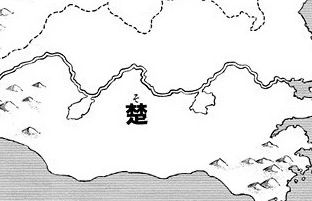
The State of Chu, (楚, Chǔ), or otherwise called the "Superstate of Chu", is the largest single Warring state and is located in the southern border of China. It is considered a superstate as its capable of wiping a state off the map if they so choose too. Because of that, other states typcially prefer to avoid conflict with the state of Chu.
Geography[]
The entirety of Chu encompasses a large landmass that borders Qin, Zhao, Han, Wei, and Qi. The Yangtze River flows through the country. It is known to be a superpower and its size is equal to that of the other six states combined. Despite this, they are wary of who they attack as they share borders with 5 different states and could be invaded by any if they strike at one.
History[]
At one point, Chu only had half its territory while Qi had the other half. But due to a joint coalition of the states, Qi lost all their possessions in the south which Chu absorbed into their kingdom. They have a strong military and normally the other states are wary of starting a war with them.
Once, years ago, one of Qin's Six Great Generals Ou Kotsu tried to conquer some of Chu's territories to which the Great General "Tiger of Chu" Kou En sent an army, led by a younger Kan Mei in his younger days, to meet the aggressors. Surprisingly, Kan Mei managed to wound Ou Kotsu with a single cut of his sword and forces him to retreat back to his homeland ashamed of his defeat. That failed invasion attempt at Chu's lands was swiftly covered by Qin. However, there were opposing rumors that Kan Mei was the one that had been defeated and covered up by Chu. The land south of Chu is inhabited by the people of Baiyue and this wild frontier could be seen as a training ground for Chu Generals as was seen for Rin Bu Kun.
Story[]
Culture[]
Pride in Superiority and Scale[]
Chu’s people and military alike take immense pride in their kingdom’s size and power. As the largest of the Warring States, Chu regards itself as the natural hegemon, not only in military might but also in civilization and prestige. The title of “superstate” is repeated with near-religious conviction by its generals and soldiers, functioning as both a political claim and a cultural identity.
This pride manifests as open arrogance toward all other states. Chu views all the other states as inferior. Its generals have been seen dismissing them as “puny” and “feeble,” and even Qin, despite its growing dominance, is derided as a nation of “mountain monkeys,” a phrase reflecting Chu’s disdain for the rough, frontier-born culture of its western rival. To the Chu, power and refinement are inseparable, and the mere scale of their army and population is seen as proof of inherent superiority.
This belief in their own exceptionalism shapes Chu’s collective mentality: to be from Chu is to belong to the greatest of all realms. Their pride is not defensive or symbolic, it is loud, aggressive, and constantly expressed, forming a core part of both their martial and social behavior.
Loudness, performance, and battlefield culture[]
Chu’s military culture is the most flamboyant and performative in the Warring States. Its generals are not only tacticians but also showmen, often delivering grandiose speeches or chants before engaging in combat. These displays are designed to intimidate enemies and exalt the state’s reputation.
General Rin Bu Kun hyping its army before battle
Scenes such as the one where the Chu army roars, “Who are the men that cause the earth to quake? The Chu Army!” perfectly encapsulate this attitude. The Chu military sees itself not merely as an armed force, but as a living symbol of the kingdom’s greatness. Theatrical displays of unity and power serve both as morale-building rituals and as political statements, reminders to friend and foe alike that Chu remains the mightiest of all states.
This culture of collective performance also reflects the Chu people’s emphasis on image and reputation. Victory is not only about strategy or conquest; it is about how the victory is achieved and perceived. Their generals often announce their attacks loudly and publicly, using ceremony and spectacle to affirm their superiority. Even in defeat, Chu soldiers and officers display defiant pride, ensuring that their image of dominance endures regardless of outcome.
Arrogance and hierarchical worldview[]
Chu’s political and cultural identity is structured around an implicit hierarchy where Chu stands at the top and all other states are subordinate. This worldview is expressed through both language and behavior. Chu citizens and officials treat foreigners with condescension, seeing them as weak and insignificant.
This arrogance is not confined to individuals but extends to state policy and military behavior. Chu operates under the assumption that its size alone legitimizes its rule and ambitions. This mentality often leads to overconfidence on the battlefield, with generals underestimating opponents due to their belief in the inherent superiority of Chu forces. Such confidence, while inspiring for Chu troops, has also resulted in costly miscalculations. Yet even after setbacks, Chu rarely questions its fundamental sense of supremacy.
Within the state, hierarchy is reinforced by constant references to Chu’s exceptional status. The royal court, the generals, and even the common soldiers share a collective conviction that they are members of a civilization apart from and above the rest of the Warring States.
Reputation and the cult of image[]
Reputation occupies a central place in Chu’s cultural psychology. More than any other state, Chu’s elite and military are deeply concerned with how they are perceived by others. Public displays of strength, confidence, and grandeur are seen as essential to maintaining the state’s honor.
A Chu general’s battlefield conduct is often designed with reputation in mind: roaring declarations, exaggerated confidence, and loud proclamations of Chu’s might serve to reinforce both internal morale and external awe. Even their interactions with enemy commanders emphasize this, Chu’s officers rarely show deference, preferring to assert dominance through mockery or bravado.
This obsession with prestige extends to the kingdom’s diplomacy and warfare alike. Chu’s strategy often aims to reaffirm its reputation as the greatest state rather than to achieve purely pragmatic objectives. The state’s culture of pride thus functions both as motivation and as a constraint, it strengthens unity and morale but makes humility or caution culturally unacceptable.
Craftsmanship and metallurgy[]
Beyond its martial spectacle, Chu is also renowned for its advanced metallurgy and weapon craftsmanship. The state’s large population and resource-rich territory enable the mass production of high-quality arms and armor. Chu’s blacksmiths and artisans are recognized across the continent for their skill in forging durable weapons and ornate military equipment.
This expertise in metallurgy supports Chu’s self-image as a nation of power and excellence. Superior weapons are not merely practical tools but symbols of prestige, material proof of Chu’s cultural and technological superiority. The state’s distinctive blades, spears, and armor designs are often used to demonstrate craftsmanship and wealth, reinforcing the idea that Chu’s martial dominance is as much a product of artistry as of manpower.
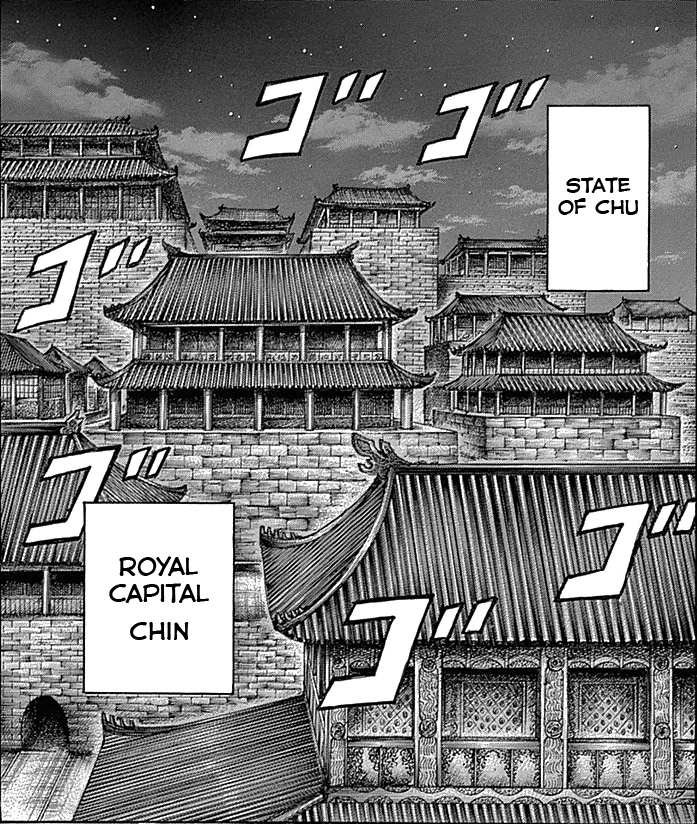
The former Royal Capital Chin of Chu
Government[]
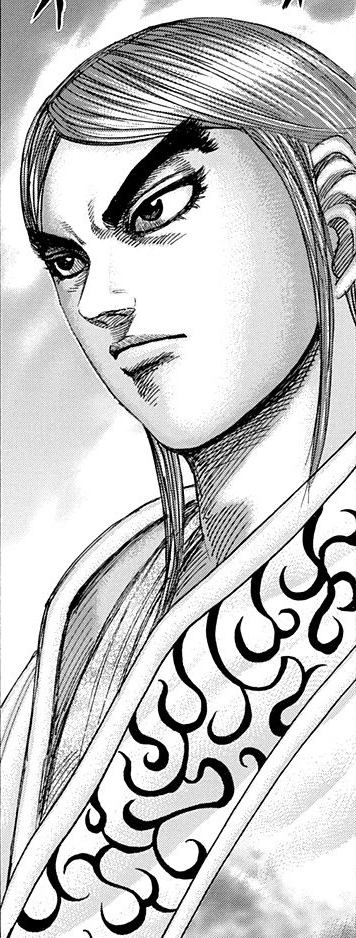
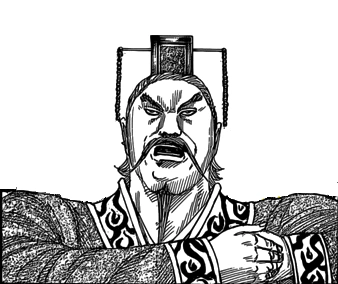
The state is a monarchy and was ruled by 23rd king Kou Retsu, with Shun Shin Kun as the prime minister. Together they ruled Chu with an Iron fist for decades. After the death of those two important political figures, the Prime Ministers became Ri En and Ka Rin, under the "Double Prime Minister System". This system stabilized the government within a month.
Royal Family[]
Prime Ministers[]
Officials[]
Citizens[]
[]
| Chu | |
|---|---|
| Royal Family | Kou Retsu † Shun Shin Kun |
| Prime Minister | Shun Shin Kun † • Ri En • Ka Rin • |
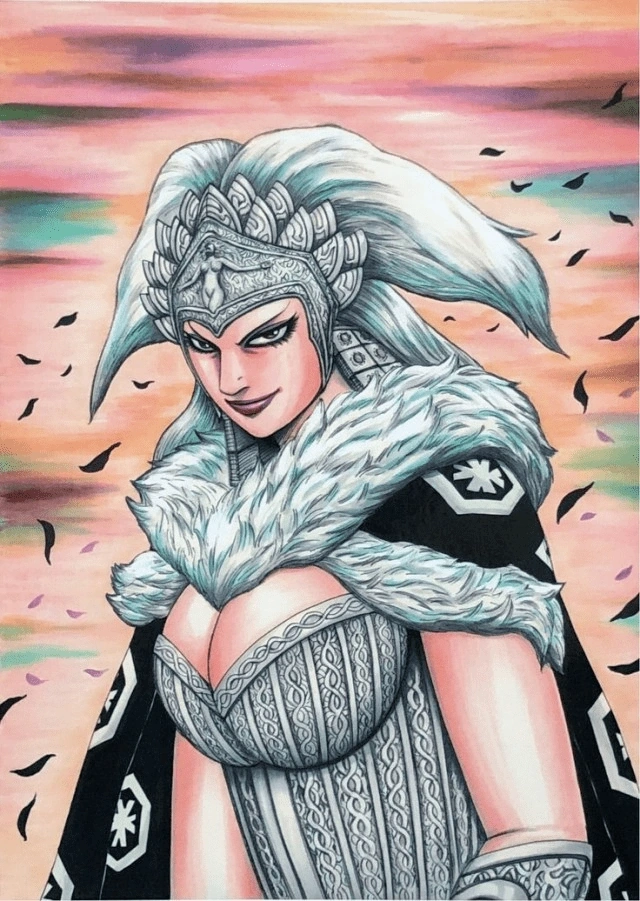
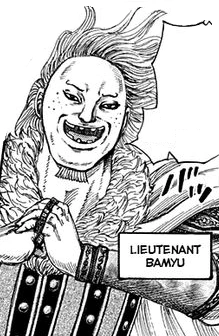
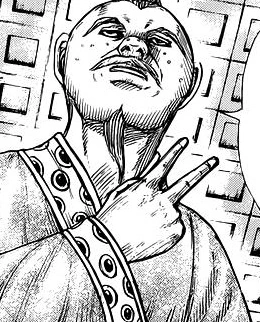
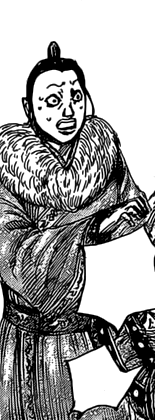
| Officials | Ri En • Ko Reki • Hoku Ryou • Bam Yu • Hou Chiku • |
| City Lords | TBA |
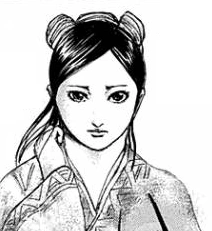
| Citizens | Haku Sui |
| Military | |
| Great Generals | Ka Rin • Kou En • Kan Mei † • |
| Generals | Kou Yoku • Haku Rei • Bei Man • Gou Ma Sho • Rin Bu Kun † |
| Strategists | Jin Ou • Bei Man • Gou Ma Sho • |
| Commanders | Bam Yu • Ka En • Gou Toku • Shin Ka • Kai Hou • Goku • Ro Kin • Koku Shi • Kyou Bou |
| Soldiers | TBA |
| Affiliates | Ren Pa • Ren Pa Army (Kai Shi Bou • Kyou En •) • Man'U • Sen To'Un • Gen'U • Ju Ko'Ou • Man'U Army (Sen To'Un Army • Gen'U Army) |